






Collision Coverage
Although often conflated with comprehensive coverage, collision insurance is a freestanding portion of your auto policy with specific coverage and its own deductibles. In the event you have an accident for which you are at fault, collision coverage will pay for the repair or replacement of your vehicle, up to its actual cash value less any deductible. Without collision protection, you would be fully financially responsible for damage your vehicle sustains in an at-fault accident. State laws typically do not require collision insurance, so the coverage is optional but strongly recommended for most drivers. Read on to learn more about what collision protection can do for you and if including in your policy is the best choice.
What Protection Does Collision Insurance Offer?
When you carry this form of coverage, anytime your vehicle collides with another car or an object, collision insurance will pay for the damage to your vehicle, assuming the accident was your fault. If you were not at fault, the other party's liability coverage would pay for the damages. Collision coverage applies if you hit another vehicle, a streetlamp, a wall, and most other inanimate objects. Like comprehensive coverage, collision auto insurance has its own set of deductibles that you choose when you add the protection to your policy. Deductibles can range from $0-$1000 or higher, depending on the carrier.
Should You Add Collision to Your Policy?
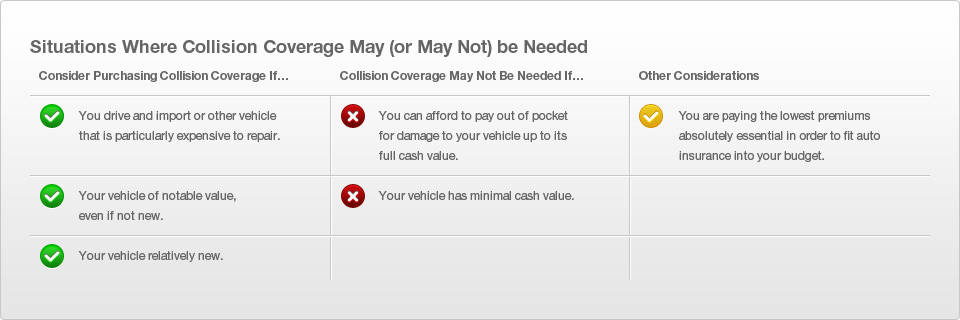
For the vast majority of drivers, the relatively small cost of collision insurance is well-worth the substantial financial protection in the event your car is ever damaged in a covered loss. When determining whether to include collision coverage in your policy, you should primarily consider your economic status and vehicle type. Drivers who could afford to absorb the repair costs for their vehicle in the event of an accident are probably financially better off excluding the coverage, for example. On the other hand, drivers who could not pay for these expenses, which could rise as high as the full value of the car, should invest in collision protection.
The year, make, model, and value of your vehicle should also factor into your decision on whether to purchase collision insurance. If your vehicle is new and/or has a substantial cash value, collision is worth carrying. Likewise, if your vehicle is particularly expensive to repair-because it is an import, for example-collision is worth the extra premiums. On the other hand, if you drive an older car with minimal or no actual cash value, collision coverage would end up costing you more in premiums than it is worth.
![[X] (click to close)](/images/x_close.png)